If you want the same dependable cup from one bag to the next, start with a blend; if you want to explore how place and harvest shape flavor, try a single origin. The choice is about the experience you want, not a ranking of quality. A blend can suit an everyday cup, while a single origin can make the character of a particular growing place easier to explore.
Both options can make excellent coffee. Your decision may depend on the flavors you enjoy, how much consistency matters, whether a bag stays available, and how you brew. A familiar house blend can be a practical routine choice; a changing single origin can make each new bag feel like a discovery.
Key Takeaways
- A blend is a useful starting point for a repeatable everyday cup.
- A single origin can help you explore the character of a place and harvest.
- Neither label guarantees a specific quality level or price.
- Your brew method and preference for black coffee or milk drinks can guide your choice.
- Begin by deciding whether consistency or discovery matters more in your next cup.
Single-Origin vs Blend: What Do the Labels Mean?
A single-origin label can identify anything from a specific farm lot to a whole country, depending on the roaster’s definition. Single origin describes sourcing, but the label alone may not tell you exactly where the coffee grew. Terroir means the growing conditions of a place, including its soil and weather, that influence coffee flavor.
The label’s precision depends on the details the roaster shares. A coffee can come from one farm, a lot within that farm, a region, or a country. In 2026, roasters also use blends with similar coffees as replacements when a component runs out, helping maintain availability year-round. A blend’s sourcing definition covers coffee combined from multiple origins.
A single-origin label can name a farm lot or a broad area. Read the bag to see how precise the origin information is.
How specific can a single-origin label be?
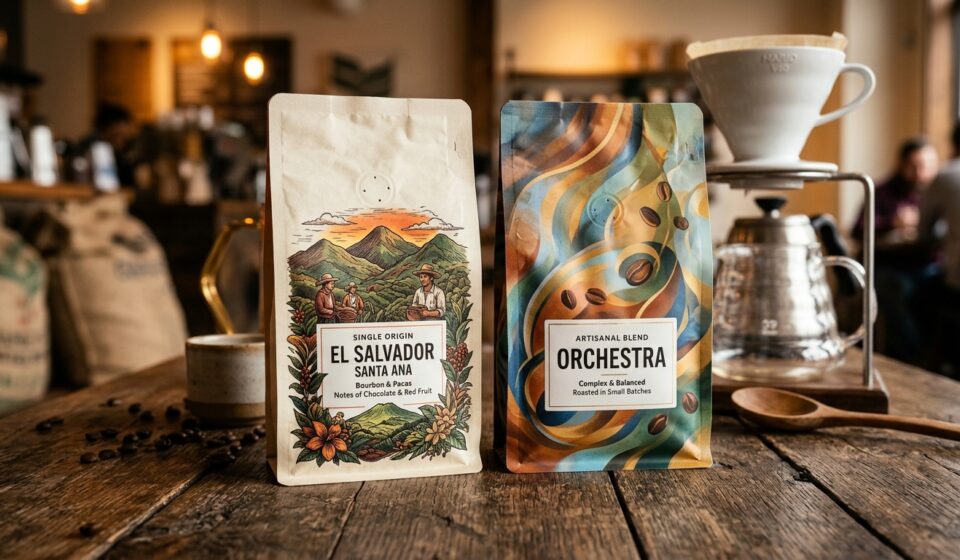
A single origin coffee label does not always mean one farm or one lot. Some origin coffee packaging names a producer or farm; other bags identify only a region or country. The word “lot” usually points to a more specific batch, though the bag’s details determine how much you can learn about it.
More precise details can help you compare origin coffees over time. A named farm or lot gives you a narrower point of reference than a country label. Still, a broader region label can be useful when the roaster does not provide farm-level information.
What makes a coffee a blend?
A blend combines coffee beans from two or more origins. The label may name the countries or regions, or it may simply use a product name such as “house blend.” A bag can still describe its component origins even when it does not identify each farm.
Look for the roaster’s description of the components and their geographic scale. A named lot gives more detail than a country alone, while a blend label tells you that multiple origins contribute to the coffee. Check whether a bag names a farm, a lot, a region or only a country before assuming how precise its origin information is.
How Do Single Origins and Blends Differ in Flavor?
A single origin gives you a clearer taste of a particular place and harvest, while a blend is composed to reach a chosen flavor balance. Place and harvest can shape a single-origin profile, and weather can change the flavor of an agricultural crop from year to year. A single origin may taste different across harvests, even when its label stays the same.
Depending on the coffee, notes may suggest fruit, flowers, sweetness, earth, or wood. Arabica is often described as sweet, fruity, floral, and complex; Robusta is often described as earthy, bitter, woody, and bold. These are possible profiles, not promises of what every person will taste.
Variety also affects the cup. Arabica has about 1.2% caffeine, while Robusta has about 2.7%. The Specialty Coffee Association’s Coffee Value Assessment records sensory traits such as aroma, flavor, texture, and aftertaste with standardized terms.
During a cupping, compare these three cues as the coffee cools:
- Fragrance before you sip
- Perceived sweetness and acidity
- Aftertaste as the cup cools
Use the same tasting cues for different coffees, rather than relying on memory of yesterday’s cup. Taste the coffee as it cools, since its sweetness, acidity and aftertaste can become easier to distinguish.
Why Do Roasters Blend Coffee, and What Affects Its Cost?
Roasters blend coffees to maintain a chosen cup profile when a component changes or becomes unavailable. A target profile can bring together body, acidity, and flavor, with components adjusted as needed. Similar coffees can sometimes replace a blend component while preserving its intended character.
In 2026, blends were described as formulations that can use similar coffees as replacements when a component runs out. That flexibility can support availability throughout the year. Single-origin coffee, by contrast, may depend on a particular crop or lot.
Flexible blend components can help roasters keep a familiar profile in stock, though a replacement may still bring a small change to the cup.
| Factor | Single-origin coffee | Blend |
|---|---|---|
| Cup target | place and harvest character | a target profile |
| Crop response | flavor can change between harvests | similar components can be substituted |
| Availability | a specific lot may be seasonal | components can support year-round availability |
Blends are often more accessible, and single origins can cost more, especially when lots are scarce. That pattern is not a rule: neither the label nor a higher price guarantees a quality level. A costly bag may reflect scarce sourcing, while an affordable blend can still be carefully made.
Compare the bag’s origin, lot and sourcing details rather than treating a higher price as proof of better coffee.
What Are the Different Types of Coffee Blends?
Blend labels describe different goals, from an espresso shot with stable crema to an adaptable house coffee for several brew methods. The name can signal a style, but roasters do not all use labels in exactly the same way. Read the blend description and variety details instead of assuming the name sets a fixed recipe.
Arabica and Robusta are coffee varieties, not roast levels or origins. The International Coffee Organization’s glossary definition of Arabica identifies it as coffee produced from the Coffea arabica species. A coffee blend can combine these varieties or use Arabica beans alone.
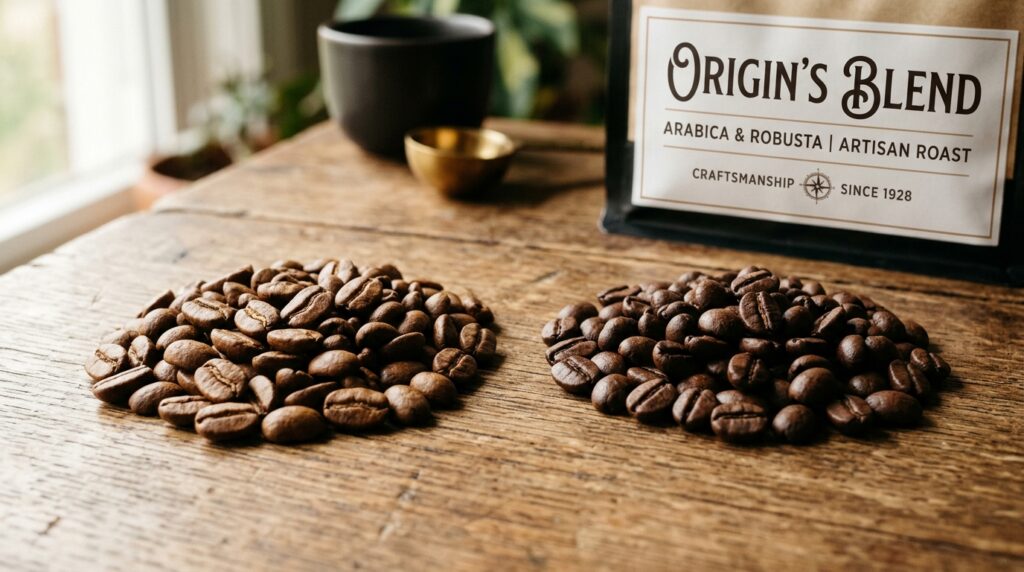
Arabica, Robusta and 80/20 labels
Some espresso blends include 10-30% Robusta, with the rest Arabica. A more common range is 10-15% Robusta to help stabilize crema, but not every espresso blend contains Robusta. Starbucks says it buys only 100% Arabica coffee beans.
A product listing from Bili Hu names a medium-roast coffee “80 20 Arabica Robusta Blend” and identifies its coffee varieties as Arabica and Robusta. The listing gives the product name and varieties, but those details alone do not establish the exact component proportions. Check each bag’s own wording.
Breakfast, house, dark roast and espresso blends
Breakfast blends are commonly light to medium roasts intended for drip brewers and French presses. House blends are often medium roasts designed to work across several brewing methods. These are broad style descriptions, not fixed standards for every roaster.
Dark roast blends are bold and full-bodied, with lower perceived acidity, and are often suggested for French press or cold brew. Espresso blends aim for a cup that works as a shot or in milk drinks. The names tell you a likely use, but the tasting description gives more useful detail about a specific coffee.
Some specialty roasters use post-roast blending: they roast components separately before combining them. This approach helps when different coffees need different roasting curves. It is one way roasters can manage a blend’s profile without making every component follow the same roast development.
Treat “80/20” as a ratio label to verify on the package, not as a guarantee that every product uses the same bean order or formulation.
Which Coffee Works Best for Each Brewing Method?
For black pour-over coffee, start with a single origin; for repeatable espresso or milk drinks, a blend is often the easier choice. The brew method matters because extraction and added milk can change which parts of a coffee stand out. A blend is a practical starting point when you want a familiar result across espresso drinks.
Single-origin coffee suits black coffee, cupping, and exploration because you can focus on its particular character. Blends are common for espresso, milk drinks, and everyday use. Their designed balance can make them a forgiving choice when you want a repeatable cup.
| Brew method | Useful starting choice | Why |
|---|---|---|
| Pour-over | single origin | to highlight distinctive notes |
| Drip | either type | blends offer a forgiving everyday option |
| Espresso and milk drinks | blend | balance and flavor can remain noticeable under milk |
| French press or cold brew | a dark roast blend | for a bold, full-bodied cup |
Espresso blends often work well in milk drinks because chocolate and sweetness notes can remain noticeable under steamed milk. Breakfast blends are commonly suited to drip brewers and French presses, while dark roast blends are a starting option for French press or cold brew.
A single-origin espresso can also work when you want to explore the coffee’s particular character. If you prefer a single-origin espresso, expect its distinct flavor to vary more than a familiar house blend.
How Can You Taste Coffee and Keep It Fresh?
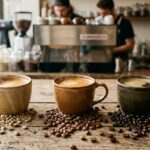
A side-by-side cupping is a practical way to notice flavor differences that can be hard to detect from memory alone. Tasting together lets you compare fragrance, flavor, texture, and aftertaste while each cup is close in temperature. Use the same preparation for each coffee so the comparison stays useful.
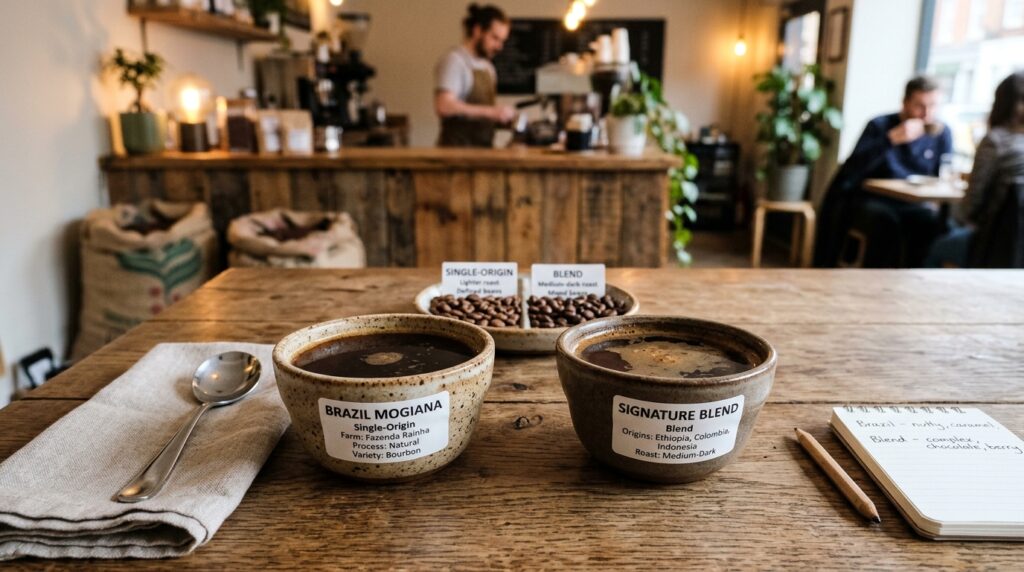
You can also mix two contrasting single-origin coffees by weight before brewing. A 70/30 experiment gives one coffee the larger share and lets you hear how the smaller portion changes the result. Keep a note of the proportions and what you notice.
One commonly cited 15-15-15 guideline recommends using roasted coffee within 15 days, brewing ground coffee within 15 minutes of grinding, and drinking brewed coffee within 15 minutes of preparation. This 15-15-15 guideline is a freshness prompt, not a strict quality boundary.
- Use roasted coffee within 15 days.
- Brew ground coffee within 15 minutes of grinding.
- Drink brewed coffee within 15 minutes of preparation.
Another version recommends roasting green coffee within 15 months of harvest, using roasted coffee within 15 days, and brewing ground coffee within 15 minutes of grinding. The two versions differ in their first and last timing points.
Coffee can remain drinkable beyond these windows. Roast level, packaging, and storage all affect how long coffee keeps its freshness, so the guideline is not a deadline. Use the 15-15-15 guideline as a freshness prompt, not a deadline after which coffee becomes undrinkable.
How Do You Choose a Bag for Your Daily Cup?
Choose the bag that fits the job you want it to do: a dependable daily cup or a distinct coffee to explore. Your routine is a useful filter: a blend can suit repeatable daily brewing, while single-origin coffee gives you a chance to explore a particular origin. A two-bag approach can give your household both a familiar option and a coffee for exploration.
Origin labels describe sourcing, not purity or safety. “100% coffee” means coffee is the sole ingredient, while “single origin” and “blend” tell you how the coffee was sourced. Packaged food ingredient labels identify the ingredients in a product.
Single-origin and blend labels do not establish purity or rank brands. Check the ingredients when you want coffee to be the product’s only ingredient.
Match the coffee to your routine
Think about what you make most often and whether you want to repeat a familiar cup or try a different origin. A routine bag does not need to be the same type for everyone in a household. You can keep one blend for daily use and a single origin for weekends or side-by-side tasting.
Use this checklist before choosing:
- Your preferred brew method
- Whether you drink black coffee or milk drinks
- Whether you want repeatability or variety
- The label’s ingredient and origin details
Read beyond the origin or blend label
“Which coffee brand is the purest?” cannot be answered by the sourcing label. A single origin or blend does not prove purity or establish a brand ranking. If “100% pure” means no added ingredients, look for coffee as the sole ingredient.
Brand-safety questions also need care. Do not treat an origin label as evidence of safety, and do not name a least-toxic winner without comparable independent evidence. Look for clear ingredient information and specific, verifiable testing claims instead.
Check the ingredient list for coffee alone when purity is your concern, then choose between repeatability and origin character.
Conclusion
The right bag is the one that suits the cup you want most often. A blend is a strong starting point for a repeatable daily cup, while a single origin is a strong choice when you want to taste place-specific character.
Neither label alone determines quality. The roaster’s sourcing details, the coffee itself, and how you prepare it all shape what reaches your cup. Your own preference is the most useful test.
Choose one option for your next brew, note what you enjoy, and use that experience to guide your next bag.
FAQ
Is single origin coffee the best?
Do Starbucks use robusta or arabica?
What are the different types of coffee blends?
What is the 15-15-15 coffee rule?
What is the 80/20 rule for coffee?
What is the least toxic coffee brand?
What coffee brands should I avoid?
Which coffee is 100% pure?